Showing posts with label How hard can writing be?. Show all posts

Saturday, March 30, 2019

Spooky Dwarves and other strange, strange things

You'll know this sort of social post that goes around.
It goes on about how everyone buys a famous brand, but they never support a friend who is trying to get their own company off the ground. Support local, support your friends and family. It gets worse for writers and their non-reading ... associates.
Co-workers, fam, whatever, not only do these people sort of roll their eyes at the little package of paper, cardboard and glue in your hand. They ask for a free copies. Not that they intend to read it, mind you. Just so it sits on their shelf to brag about knowing a guy who writes. And even if I was foolish enough to agree to give them a free copy (can a person who designs a car give away a free car?) I'd have to ask my editor for said free copies for non-reader types. Not a great way to keep that professional relationship going.
Here soon In the Shadow of the Mountain hits shelves and is already on the interwebs with12 short stories of Horror in Secondary Worlds of High Fantasy. For us D&D types, it's Ravenloft-style fiction. When you're done reading the third story, Runes, dwarves will freak you out. 
Runes, will be my latest published short so if you liked my vignettes in Esper Genesis and like Horror, you'll enjoy this. But if you don't like Horror, I've got good news for you. I've written a thing or two here and there.

My other printed short The Icy Death of Doctor Furious, can be found in Origins and Endings, Vol. 2 and is about modern pulp as you can get. 
And if you look on my Amazon Author page, you'll see that I self-published several short stories -- and narrated my own audiobook -- a few years back. 
These stories range from Dying Earth (I'm looking at you Cypher) to serialized zombie to monster hunter to dark fairy tale and more. 
Check them out and if one tickles your fancy, don't hold back! Buy it and rate. Pleeeese rate it.
Love what you’re reading? Not only can you get the Cypher goods early, but also discover exclusive
early 5e content, world building and related fiction on my Patreon! You can also check me out at DriveThruRPG.com

Sunday, March 20, 2016

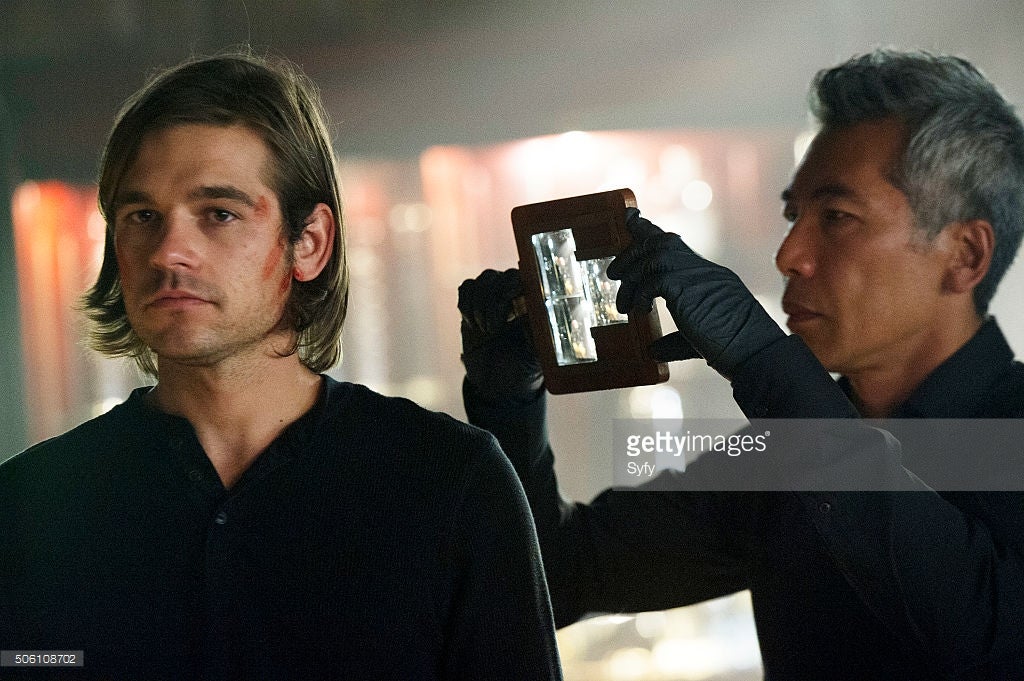
Magic is the tool, not the theme, in Magicians

I’m getting into the Magicians quite a bit, but for while it was hard to pin down why.
First off, maybe I’m reading into it too much, but let’s see. While the literanazies usually comment that much of genre fiction is “adolescent” especially for it's love of the Chosen One trope, the Magicians is more of the collegiate version.
I'll skip over the two obvious spins of that angle, the post-Harry Potter commentary and the addiction allegory, though the undertone I was having trouble articulating about seemed akin to both.
It seemed more like the addition to being a "Chosen One" ... among thousands of other “Chosen Ones” and the sacrifices you make only validate your alleged uniqueness.
Harvard? Yale? Being in the 10% of special people in country? Bah. That pales in comparison to magic school. Suck on that valedictorians!
And yet the show is already hinting that every one of these special snow flakes are all headed towards a crash of realism out in the adult magic world. Just as every wizard graduate from Brakebills will learn that  high scores only puts more expectations to deliver in a world they are outclassed for, so goes it for mundane lawyers, doctors and academia.
You see that some are already finding justifications to avoid dealing with that realization. I.E. at least they are not hedge witches, or worse yet not one of the little people who have no magic. And the hope that if they are willing to keep pushing and sacrificing, they can prove they at least belong if not stand out among peers who are already standing above everyone else. And how those older and more cunning than them are manipulating their insecurity and ambition.
So I knew it's definitely a hubris of some sort,  sometimes, but then some characters use the magic as facade to remake themselves into what they want to be. "I am own greatest creation." Just as others had used magic as something to bury themselves into to hide from their personal pains
Then I realized where I had gone wrong. 
I had assumed the writing room had only picked one theme or one trope. A lot of shows and stories do that. In the past, that was a pretty solid way to go, but I think audiences are more savvy to that now. A show has to keep moving forward now a days.
 Example? Twenty years ago, the old "Hero is stuck in a fake insanity ward" episode would have been in season four of a genre film. 
The Magicians did it as their fourth episode, season one. 
And I think that this show has taken that a step further with magic. Instead of sticking to one metaphor and running it into the ground, on fumes, with a shovel, they've embraced that magic can be many things to many people. It can be a way to power, a place to hide and even a salvation of sorts. 
It could also be a one-way ticket to a personal hell. 
So I tip my hat off to the crew of show. Keep making magic. 

Monday, October 19, 2015

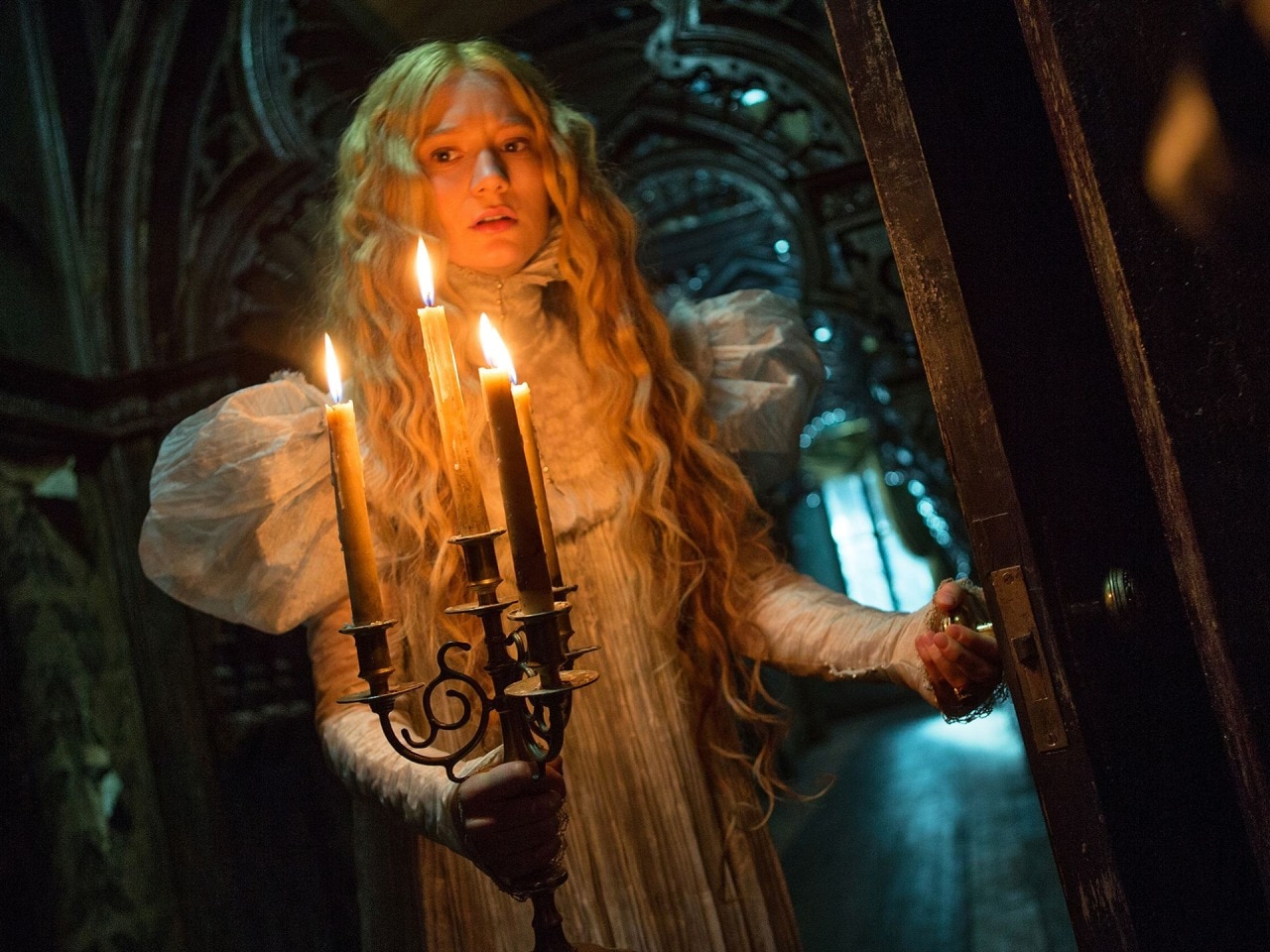
Crimson Peak Kryptonite - Lit Critics


As a writer, one thing that stood out to me was the times when someone wanted to hurt the heroine, they went straight for the figurative jugular. They dissed her manuscript.

Seriously, it might have been kinder to go literal instead.

Perhaps del Toro was channeling his own angst at having his off-kilter style judged or maybe I’m projecting. I’ll take either, or both, truth be told.

Western culture takes a different stance on writing than it does the visual and performing arts. The stereotypes, regardless of the reality, is that when individual artists and performers reach a true level of mastery after years of practice, there’s no true way to deny their achievement. And if you don’t see the true mastery, you’re a bumpkin (don’t point at the painting John, you’re embarrassing me) and there’s whole genres of art that only an acquired taste can appreciate (as in like improv jazz, interpretative dance, postmodern art, and etc.)*

Writing, on the other hand, surely can be done by anyone and thus surely anyone can be a valid critic. And genre fiction itself has long standing history where many "valid critics", both on the street and ivory tower, agree to not waste their time reading it.

While every type of creative needs a coach, writing is ultimately a collaborative art. Some writers need an Alpha reader, others need a few beta readers and almost everyone needs some proofreading help. This is before the publisher comes in with their own team of copy editors (who do the actual line-by-line editing) and editors (who are advocates who focus on the story with — or in spite of — the author.)

A beginning writer who hasn’t found a solid collaborator, someone is more than just a cheerleader, is lost — especially those who know the deck is stacked against them. For them, an unkind word cuts most deep. And in Crimson Peak, that effect was weaponized by the Sharpe family. (In this context, I’m debating if that surname is more pun or irony.)

The Internet has been a boon too young to writers in the recent past. Fan fiction is now considered a legitimate part of a career for writers, it allows for faster feedback and access to receptive audience that might embrace your work.

But these days we also know that the Internet’s evolved into a social weapon. This goes double since writers are constantly baring their souls when their work is read.

So what’s my call to action? Honestly, I don’t know if I have one in a time when stories are judged from multiple angles and agendas.

If you find that a book you read is new writer to you, or just new period, then take a little care when you do your review. If something didn’t work for you, tone down on the snark; but build up the case on why it worked in other novels. Expound on what you enjoyed, yet examine why that put a smile on your face.

As a final word, I’m not advocating that every new writer get a medal for their first effort. That first effort is going to be a horrible first pancake, but how you couch those can make a world a difference. It might give them just a ghost** of a chance at finishing that first novel.

*Side note: I have heard of an award-winning genre writer who left the field to enjoy dancing. She found the immediate appreciation of an audience to be much more rewarding than the years it took to sell her shorts.
**Sorry. Couldn’t resist. I’ll be leaving now.

Thursday, April 16, 2015

Your book, your dreams ...

Recently two things happened.

The first was that a young writer has gotten back in touch with me. He had taken an unintended sabbatical from writing because he thought he was stuck in a rut. 

He loves writing Urban Fantasy, but felt like he couldn't add anything new to the genre -- that everything had been done before. Frustrated that he couldn't come up with a story idea free of cliche or tropes, he eventually stopped writing.

Now he's aiming to be back in the saddle with the goal getting up at 5 am and try to write something every day. Bless him, he's an early riser. For me, it's much more likely that I'll get a thousand words written than get up at that verboten hour. So what's gotten him writing again?

Pretty much a forgettabout attitude. 

For most writers that discover something new, two things happen. Either they catch lighting in a bottle; or they've found a great peanut butter/chocolate mix of ideas and imagery. (The current marketing shorthand for such things is "X"-punk.) So either you need luck or you need time to mix and match things to find that right combo. Your odds of doing so improve greatly by actually writing. So start writing.

But you want to bring something unique, something awesome to the table. Well, they say there are no new ideas, that even scifi concepts -- like robots -- can trace their mythical roots to the golem and living statues that date back to the first pages of recorded history. If that's true, what can you bring that's new?

Stories are a lot like people. The great ones have heart and brains, but they also a voice. And each voice is different. That's what you bring, so bring it! 

There is a time for writer to put their ego to the side. The first draft ain't the place for that, pardner. 

Oh, there was a second thing, wasn't there?

Yep. Lately, I've been noticing that my FB  and forum posts have been getting longer and longer. I've taken that as a sign that maybe my thoughts need a bigger space to stretch their legs. So you might see me blogging a bit more in the past. 

Thursday, January 15, 2015

Gaming your writer's block away

I don't usually have writer's block, per se, as you see it in fiction,* where it's the crippling type that has the writer seemingly blank on ideas, like he's living in a white blank-paged wasteland of imagination.

It's a popular image that's (ironically) inspired different systems and techniques to beat the block. Over the past couple of years I found a few that might do the trick or they're at least fun enough to make your writing breaks a bit more creative.

The latest is a Kickstarted game by Dejobaan Games.

 Elegy for a Dead World


In this recently released PC game, you are the lone survivor of an expedition to an abandoned planet. You aren't the pilot -- or the archaeologist -- you are the poet. Your character roams the beautiful scenery and writes about what they see. You can either write free from or pick a theme, like You Realize The Whole Planet Is Artificial, that prompts your story. Players can also share, read and rate their stories on the cloud.

Roy's Story cubes


You've got  nine dice with pictures, you've got game rules on how two or more players can make a game of storytelling or play solo and see if the mental exercise can loosen up your brain blockage.


 Once Upon an Time


OUaT is a card game that lets people empty their hand as they tell a story, but other's can interrupt the flow with their tale to tell. The game ends when a player ties in their story with a unique "Happy Every After" card, which also has to be their last discard.


Not only is it an award-winning game that's been around for decades (not that I would personally know ... stop looking at me like that.) But there's also a book that turns the cards into fun writing exercises.


So there you go. More ways to incorporate storytelling into your life and fight writer's block.

Or at least a way to tell your internal editor that you're "brainstorming" for a story  when you've got dice and cards in hand.


*The things that stump me are how to express my ideas ... and the willpower to stick with an idea long enough to get it finished.

Friday, October 31, 2014

Sound check, check, check. Audiobook time.

I’ve been quiet for a couple good reasons lately. In addition to shooting out a raft of short stories out into the unforgiving world of the slush pile and creeping along with my YA novel, I've been experimenting with audiobook short stories (audioshorts?) by laying down tracks for Small Town Nights.
Here's a sample:


Luckily my buddy Ebony Jones, who has like one of the coolest real life names that I know of, did all the heavy lifting when it came to the directing and sound. I, on the other hand, was just happy to put my old broadcasting skills to use.
But every format has its own quirks, as I found out:
Pick a story that plays to your strengths -- and your limits. If you’re not the sort of person who can make up voices, find a story with only one narrator or a third person omniscient. If you're doing a story with local flavor and your natural accent add ambiance, go for it.  Small Town Nights is an example of that. It was a narrated piece where my Midwestern/Southern accent fits perfectly, once I ham it up.
It’s ten times easier to do straight narration than voices. The real challenge is when you have to come back to the studio the next day and match those same voices again. It’s harder than you think, especially when you the voices in your head are different than the ones come out of your mouth. … Even worse when the voices in your head are telling you to smother peanut butter on your chest. … I’ve had my meds, I promise.
We wasted a good half hour because I was thinking of Sean Connery, when I was really speaking like Deckard Cain. Which is fair, DC is a SC rip-off.
Even if you wrote it, rehearsal is good. Even if the writing is spot on, there’s going to be some hidden tongue twisters in there.
But being your own script-writer is great. Sometimes things that read great on the page suck when read out loud. I’m not saying that the original was bad, but in performing a piece that’s already driven by narrator I found some spots that needed more flavor -- as compared to polish. Soon, future versions of the epub Small Town Nights will have these changes.
Reformat your work. Avoid splitting a paragraph between pages. It will minimize breathing sounds and kept you from absently mindedly turning the page -- and thus reduce the amount of splicing for your sound guys. An aside here, sound guys are going through what’s already happened to Graphic and Web Designers. Since the ease of open source software and the Internet has demystified the technology somewhat, clients new the field have unrealistic expectations and expect rates lower than the industry standard. e.g. They expect a pro to “cut and paste” tracks together for $9 an hour and do it all in under an hour. 
That’s like asking me to draw an owl. You’ll get a stickman owl. Ask an artist to draw an owl:
But we both know how to put pencil to paper. The first clue maybe that the artist is going to use a charcoal pencil while I use an H2.
Home offices/studios have their challenges. Airplanes, motorcycles and thunderstorms can give you retakes or postpone a session, plan according.
The most important part though, is have Fun, as you experiment and create your own audiobook.

Wednesday, September 10, 2014

10 Things Writers Should Know about the business side of writing.

Chuck Wendig's blog is always good for shaking the proverbial writing tree and seeing what hits the ground. This week's entry by the talented Kameron Hurley reminds us that all publishers, epub or traditional, are seeing the biz differently than you. They see it literally as a business and your book, and you by extension, as a  product and a method of marketing.

If they don't see you that way, they won't be a publisher for long.

With that in mind, I've got some quick rules of thumb for you about publishers and your writing career. There are always exceptions to these, some of which prove the rule.

  1. A Writer's Vision is for marketing copy only: If you talk about your vision -- as in how a publisher doesn't get your "vision" or your genius -- it's a clue that you don't get   that a novel is a collaborative project. A good editor and publisher can be a godsend on cutting the chaff to make your book a leaner, meaner storytelling machine.
  2. Copy Editors edit, Editors advocate :  When you meet an editor at conference or con, you'll meet your story's champion. They will try to do their best for the story, not you, your story. So while that means they might go to bat for the story against the publisher, they'll also go to bat for the story against you if you insist on keeping things that distract from the focus of the story.
  3. Self-Publish? Congrats you're a publisher: Back in my early days, it was hard enough to wrap my head around the idea that proofreading wasn't done by editors -- they've got enough to handle (advocating, profit/loss statements, finding more quality stories). They hire copy editors to handle the proofing. And you should too. If you can't afford one, find a volunteer. Same goes for covers and probably marketing as well.
  4. Volunteers take their sweet time: There's that old adage that you can have two out of three things when working on a project, either fast, cheap or good. If you're getting a volunteer to help  (especially  people you shanghai in with promises of "exposure.") then prepare for them to take their time. They have lives and are doing you a favor.
  5. Consider yourself on a 10 year plan: If you look up any "New" Writer's award, you'll find a good decade of practice and exposure behind them. Some wrote in fanfic, or advertising or in other fields like RPGs or non-fiction. You are in for the long haul buddy.
  6. Writing may always be your part-time gig: There's more and more scuttlebutt that the days of a full-time novel writer maybe coming to a close, or that it's reaching a long nadir of sorts. I say this not to discourage, but to help brace you for the long slog ahead.
  7. Paid writing is paid writing -- if that's what you want: You may find that if you really want that writing lifestyle, you'll have branch out in ways that keep you at the keyboard, but not necessarily doing what you dreamed of. Fiction novel writing is one of the toughest gigs to get and there's more luck involved than most people are willling to admit. Non-fiction, advertising, how-tos, pretty much everything pays better with more frequency than a novel. 
  8. Business 101 is not Ethics 101: And Ethics 101 is that doing something legal is not the same as doing something that's ethical. As Ms. Kameron Hurley can attest, read your contracts and assume that publisher's know you're going to fight that boilerplate contract that tries to have you sell all of your rights in perpetuity for $500. Or that if you're an artists that negotiates doing your own book cover, then get paid for it as a separate item, otherwise you just did work for free.
  9. Don't write for the market, but that is the harder road: You're going to write your next novel for a minimum of two years, maybe more. You have to love what you're doing or you're lose steam. Sometimes what you think is cool isn't a slam dunk for the marketeers, and that's all right, but know you've got an uphill battle (Says the guys who is trying to pitch a Weird Western.)
  10. Live more, read more, write more: Seeing how real people live and interact, seeing how other writers tackle the same stories as you do and seeing yourself improve will help you inch closer to perfecting your craft.
  11. Bonus Round! Read and write out of your comfort zone: Creativity is like a body that needs food and exercise. And just as eating and excising the same every day short changes a body, the same goes for your writing. Try new things and stretching yourself, you may discover unexpected inspiration and new tricks.
Now go fourth, my writing comrades and write!

Saturday, August 30, 2014

The road less traveled, or maybe more traveled than not

Good ol' Chuck has another guest blog by Tom Pollack about how to juggle this crazy career we call Part-Time Writer. (Don't call it a hobby and don't call yourself "aspiring" just write, damn it!)

I'm blogging about it, so I must have a few thoughts myself on the subject. Consider them more of an extra table of goodies to Mr. Pollack's buffet of ideas. 

Plan Your Time
Beyond Planning your time, steal time back when you can. Be a complete klepto when it comes to pens/pencils, paper and your downtime. Instead of whipping out your smartphone and making Angry Birds angrier, jot down a few sentences .

This does two things; inch you closer to your weekly word count and trains you to jump into writing mode faster. Not only will have less guilt about a slow day when all those extra sentences got you over the hum, you're more likely to skip that thirty minute Internet "warm up" on io9.com if you've learned how to write a romance scene in a frigid, noisy airport.

Stick To Your Plan -- But Don't Let It Turn You Into an Asshole.
I think Tom is close to something here, but missed a bigger truth to writing. The truth that a writer pretty much a paradox who in one moment has to lock themselves in a oubliette, pull a rope to close the top and write in utter solitude and in the next moment is in the middle of humanity, seeing it for all of its wonder (and terror.)

'Cause in order to write characters that make your readers empathize with the human condition, you have to see, hear and taste that particular condition for yourself.  And you can't do that chained to your laptop. 

Enjoy It
You have to, or it will burn you out faster than roman candles duck taped to gas cans. This not only goes for the writing part but also the "go forth among humanity" part as well. 
Perhaps the best way to think of it is this way: Most people have to have their own children before they rediscover the wonder in life through the eyes of their little ones.

But as a writer, you always have to have your inner tyke on tap.


Wednesday, August 20, 2014

How much "exposure" do you need?

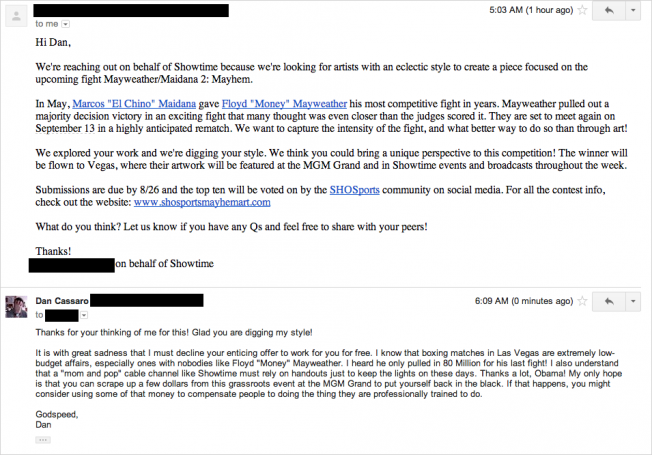
It looks like Showtime should have had a different pitch for their latest contest. Instead of promising graphic designers exposure at an upcoming boxing event, they should have labeled it a free vacation package.  That might have gone over a bit better. Or the designers who are boxing fans would be more inclined to say yes.

Though to be fair, this is an ad/PR firm working on Showtime's behalf. I'm guessing more PR than ad company.

Let's look at that email and Mr. Cassaro's response.


I'd have a few "Qs." (It's cute when ad people try to be hip.) How long are these spots? How prominent will my contact info be on these spots and at the MGM Grand? Yeah, I get exposure on the social media, which might include some decision makers for various companies that might be client material (who now know I will work for "contests.") But who do I get real face time with?

The answers are pretty pat here. The only real exposure will be on social media, which is a crap shoot (pun intended) and where it really counts at the MGM and on broadcast the answer will be "They will see your art only, no contact info. What you are asking for is almost like an ad." Well, PR/Ad firm, that is what your pitching me right? I've gotta leverage the most out of it.

Because working as a creative is a business at heart and, when you're lucky, a business with heart, but you have to make savvy decisions about your "exposure." Because frankly, it's a wash most of the time in any business.

I've seen all type, sign makers, marketing firms, and even contractors get taken in with a big client who promises "exposure" and to put your name out there if they are happy with the end result.

And then somehow it never works out.

You've put the client is now in a position of real power and they'll abuse it like crazy. Mostly by making countless changes to the project that you take the hit on to keep the client happy. You'll realize those hits have put you in red too late.

Ask the VFX companies hows that working for them.


So I'll wrap up with this classic bit from a classic curmudgeon. It's relevant.

Thursday, July 31, 2014

Yep. That's pretty much how Starbucks is.

http://pvponline.com/comic/2014/07/27/game-of-thrones

When that urge to be a "Starbucks" writer hits me, I gotta look at the time. If it's past 5pm, forget it. The 7-person knitting circle has taken all of the comfy leather chairs.

I don't make this stuff up, honest.

Wednesday, July 16, 2014

Three bags of hurry up and wait

Well, that took a bit longer than I thought it would.
The prize aspect of a writer is discipline. You got to keep your butt in the chair and keep plugging away. Even when you’re staring at a screen that says “Uploading your ebook now.” That’s not so great for my ADHD.
My plan to e-publish was two-fold. The first was to provide several short stories so that potential readers could have more content to choose from. The second was to spread my distribution among the big three -- Amazon, Nook and Smashwords.
But if you have 7 shorts that essentially means you’re uploading 21 stories. I should have thought out that math earlier. So my plan to do a massive upload in one day turned into more like a week. Technically, I could have done it in a day, but I would have gnawed off my arm by the end of it, and learning to type with one hand is a bitch.
At this point, the experience of it all is a bit blurry (having a cold that week didn’t help). But from what I can remember …
For any of the three e-publishers:
·         They will want your tax information: It’s the price (or payment) of doing business. If you haven’t incorporated yet, they will take your social security number in lieu of your tax ID number.
·         If you have the  .doc file and a short story, you’re all set: it’s savvy to learn how to set up your formatting and TOC for your novel in Calibre or Scribe. If you have a .doc (not .docx) file, though, all three publishers have online conversion tools that should work for short stories.
·         Each company has different cover sizes and they change without notice: Do your homework on the covers.
·         For all the talk of how traditional publishers want to straightjacket you into a marketable niche, the genre labels for these companies are mostly either generic or what’s trending. If you happen to have a post-apocalyptical Science Fantasy short in the vein of Vance’s Dying Earth, good luck with that getting lumped into Science Fiction, Apocalyptical, and Adventure. And the Fantasy genres will only touch on Epic, General or Contemporary/Paranormal.  If you’re lucky, you could find Steampunk. Unfortunately, the pull-down menus for these are clunky. I’ll get to tags/labels with each publisher.
·         And no matter the publisher, if you have more than one book online, then you probably aren’t going to be happy on how you have to drill down in the reports to see what’s really going on with the sales numbers. That’s for just 7 stories. I can’t imagine what hoops the writers who have dozens of stories have to jump through to understand their data.
·         A “Same entry as last time” for things like author, publisher and price would make the process much less of a time suck.
·         Have a “cheat sheet” of your blurbs, tags and author bio handy to do a lot of cut and paste
Now for the individual guys:

Amazon:
You sly, sly dogs. I’ve already said that Amazon tries to make themselves a convenient one-stop shop for an author. They allow you to use Styles from Word to set up the formatting for TOC and offer a gallery of customizable book covers. However, then they’ll try to tempt you to go exclusive with them. (But do you really want only one company holding all the cards at the end of the day?)
Amazon only allows 7 tags for your product and offer limited genre choices. The biggest positive is that I saw one or two instant sales -- but then afterwards, nothing.  My cynical side wants to think that Amazon has a slush fund for buying the first copy of a writer’s work. If they can keep you hoping, then you’ll keep putting out content.
Not that I have any proof of such a silly idea. Maybe I should just pat myself on the back that I got lucky day one.
Uploading takes forever and you can’t really go on to the next project as you wait. The whole process happens over several different screens.
The actual publishing of your ebook takes 24 hours.
Nook:
Nook doesn’t offer you a free cover, but they do try to make themselves your browser-based word processor/Scrivener project manager. If you have any bold or italics in your document, you’ll have to go back and add them in via the Nook system.
I seem to remember this one was the most clunky to work with, though they seemed to have the most flexible system for cutting and pasting your tags in.
Again, uploads take forever and it seems that you take chances if you try to skip to the next project. You have to go through several screens related to different silos (price, audience, actual upload).
The upside is, they publish your ebook in a few hours.
Smashwords:
How I hate and love you.
Smashwords had the only single upload screen process, which was great, and the process actually invites you to upload something else as your ebook is translated in any format you need. Neat.
But SW has the most proprietary system for formatting your work (which at the very least means including a copyright that names your submission a “Smashwords Edition.”) For example, Their Word TOC system works off Bookmarks, not Styles and other odd bits.

->TL:DR Read their handbook. It will save you from a lot of grief later.
Even though the actual upload is painless, it take days -- yep days – for a story to go live. It makes me imagine that they have a light-starved gnome locked in a server box, reading every upload by the light of a candle and a Sega Genesis.
I still believe enough in my strategy that I’d do it again. But in the future, I’ll be adding individual stories and remember that I have to multiply my efforts by three.  
’Cause as an ebook author, there’s no such thing as bulk shipping.

Monday, October 7, 2013

Write Short To Write Long?

In my effort to procrastinate, this let to that advice from John Scalzi. So the advice he gave was Write Short To Write Long.

I tried to find where he's said that before, but didn't have any luck.

Right now (heh. I almost misspelled that in a very subconscious way), I'm taking a break from the final polish on my novel by banging out some short stories. The plan is that most of shorts will go up, self-publishing style to create that "critical mass" where if a reader enjoys one short, he can find a few others while he's still in a buying mood.

Sort of like offer another fudgey chocolate chip cookie while a friend is still holding a cold glass of milk. How can he say no?

 Ironically, these shorts are taking longer than expected. Each one has to have a new concept even if it shares the same characters. And the villain has to be different in each one.

At some point, I hit a stride in a novel. The characters seem fleshed out and the villain's vision is clear. From that point, the rest of the first draft is writing the fallout of all that. The rewrites patch holes in the continuity and certain events get a new focus or spin so that drama and character growth happen more consistently.

So not only does Mr. Scalzi's advice leave me non-plussed for now, it seems that I'm writing long for short.

Not my most productive month so far. :P